
37 lessons. From zero.
Robin teaches the careful way: short lessons with real charts and pictures, a quiz at the end of every one, and a practice task to try on real price history. New tracks open as the story goes on. Free players get the first 12 lessons, including risk and scam safety; Climb Pro opens the rest.
Foundations
Opens in Chapter 1 · 6 lessons · 32 minutesMarkets, candles, levels, indicators, orders and position size.
 What a market isBuyers, sellers, and the three coins you'll trade with: BTC, ETH and USDT. · 4 min · 5-question quiz
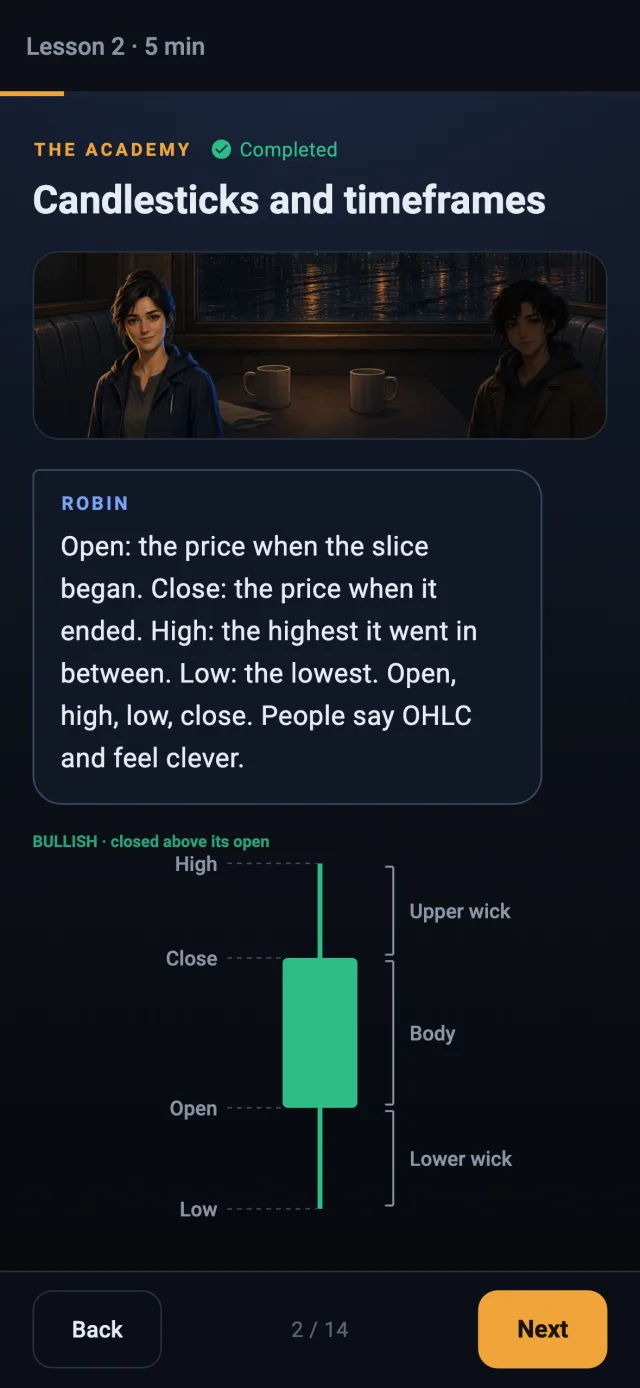
 Candlesticks and timeframesFour numbers per candle, and why zooming out changes the story. · 5 min · 5-question quiz
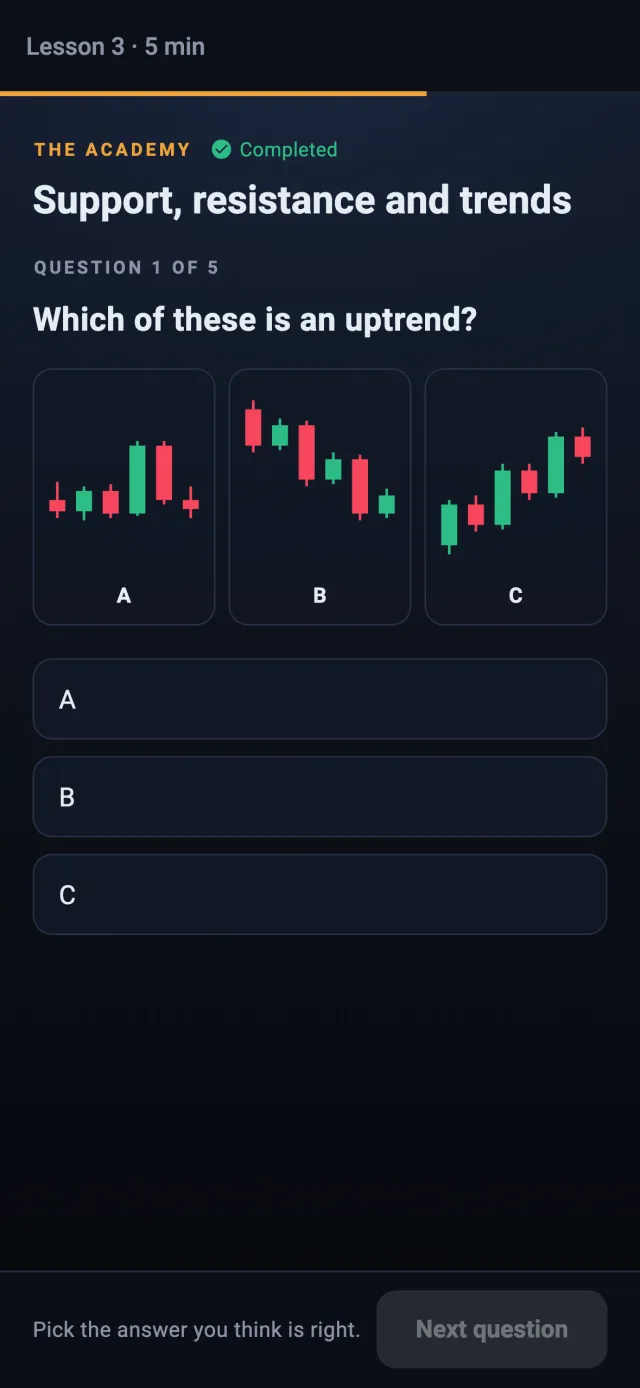
 Support, resistance and trendsWhere price tends to stop, and how to tell which way it's going. · 5 min · 5-question quiz
 IndicatorsMoving averages, Bollinger Bands, RSI, MACD and volume: what they measure, and what they don't. · 6 min · 5-question quiz
 Order typesMarket, limit, stop, stop-limit, take-profit, trailing stop, OCO — and the bracket I build every trade with. · 6 min · 5-question quiz
 Position sizing and your risk ruleHow big to trade so that being wrong costs only what your own rule allows, fees included. The classic rule is 1–2%. · 6 min · 5-question quiz
Risk and money Pro
Opens in Chapter 2 · 5 lessons · 31 minutesReward to risk, costs, drawdowns, managing a trade and writing your own rules.
 Reward-to-risk and expectancyMeasure every trade in R, and see why a win rate on its own tells you nothing. · 6 min · 5-question quiz
 Fees, spread and slippageThe small, certain costs on every trade, and how fast they eat a small account. · 6 min · 5-question quiz
 Drawdowns and the math of recoveryWhy a loss needs a bigger gain to undo, why losing streaks are normal, and why small risk survives. · 6 min · 5-question quiz
 Managing an open tradeWhen to move a stop and when not to, break-even stops, trailing stops, targets and partial exits. · 7 min · 5-question quiz
 Writing your own rulesRisk is your call in this game. Write your rules, and let the game hold you to them. · 6 min · 5-question quiz
The crypto world
Opens in Chapter 2 · 6 lessons · 37 minutesBitcoin, Ethereum, stablecoins, exchanges and wallets, scams, and doing your own research.
 What Bitcoin isA ledger kept by thousands of computers, mining, the 21 million cap, halvings, its unknown creator, and its wild price history. · 6 min · 5-question quiz
 Ethereum and other coinsSmart contracts, ether as fuel, proof of stake since 2022, tokens and altcoins — and why most small coins die. · 6 min · 5-question quiz
 StablecoinsCoins built to stay worth a dollar: what holds them up, how the peg breaks, and why the game counts in USDT. · 6 min · 5-question quiz
 Exchanges, wallets and custodyWho really holds your coins, why exchanges have collapsed, seed phrases, and hot versus cold storage. · 6 min · 5-question quiz
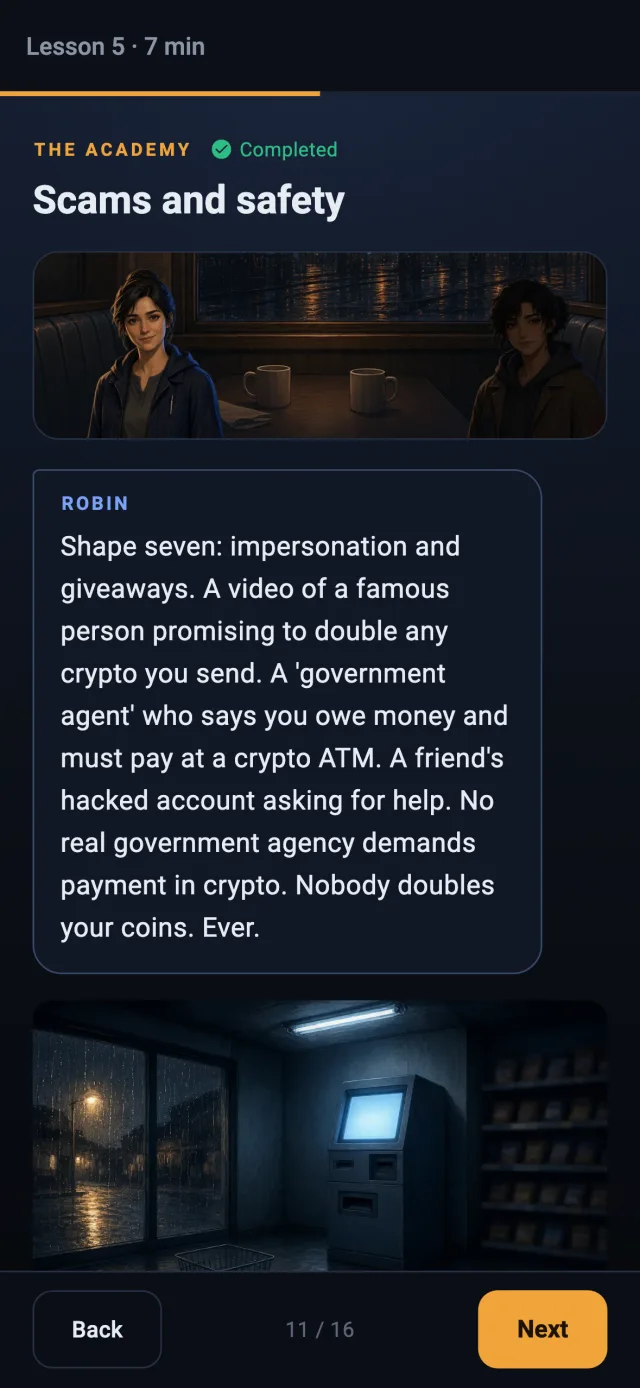
 Scams and safetyThe shapes crypto scams take, a red-flag checklist, and exactly what to do if someone targets you. · 7 min · 5-question quiz
 Doing your own researchWhy the game has no news feed, how to check a claim, facts versus stories, and the question 'who benefits if I believe this?' · 6 min · 5-question quiz
Trading psychology Pro
Opens in Chapter 3 · 4 lessons · 21 minutesFOMO, revenge, overconfidence, loss aversion and the habit of review.
 FOMO and chasingWhy buying after a big green move feels right and usually isn't, and why a missed move costs nothing. · 5 min · 4-question quiz
 Revenge trading and tiltThe loss, the bigger trade, the bigger loss — how the spiral works, how to spot tilt, and how to stop it early. · 5 min · 5-question quiz
 Overconfidence and loss aversionWhy a winning streak makes you careless, why you cut winners and hold losers, and why the process matters more than one result. · 6 min · 5-question quiz
 The journal and the weekly reviewWhat to write down for every trade, the questions to ask once a week, and how to find your own patterns. · 5 min · 5-question quiz
Reading the market Pro
Opens in Chapter 3 · 6 lessons · 39 minutesStructure, timeframes, candle and chart patterns, volume, volatility and sessions.
 Market structureHigher highs, lower lows, ranges — and what a change of trend actually looks like. · 6 min · 5-question quiz
 Multiple timeframesTop-down: the daily sets the direction, the 4-hour finds the level, the 15-minute times the entry. · 6 min · 5-question quiz
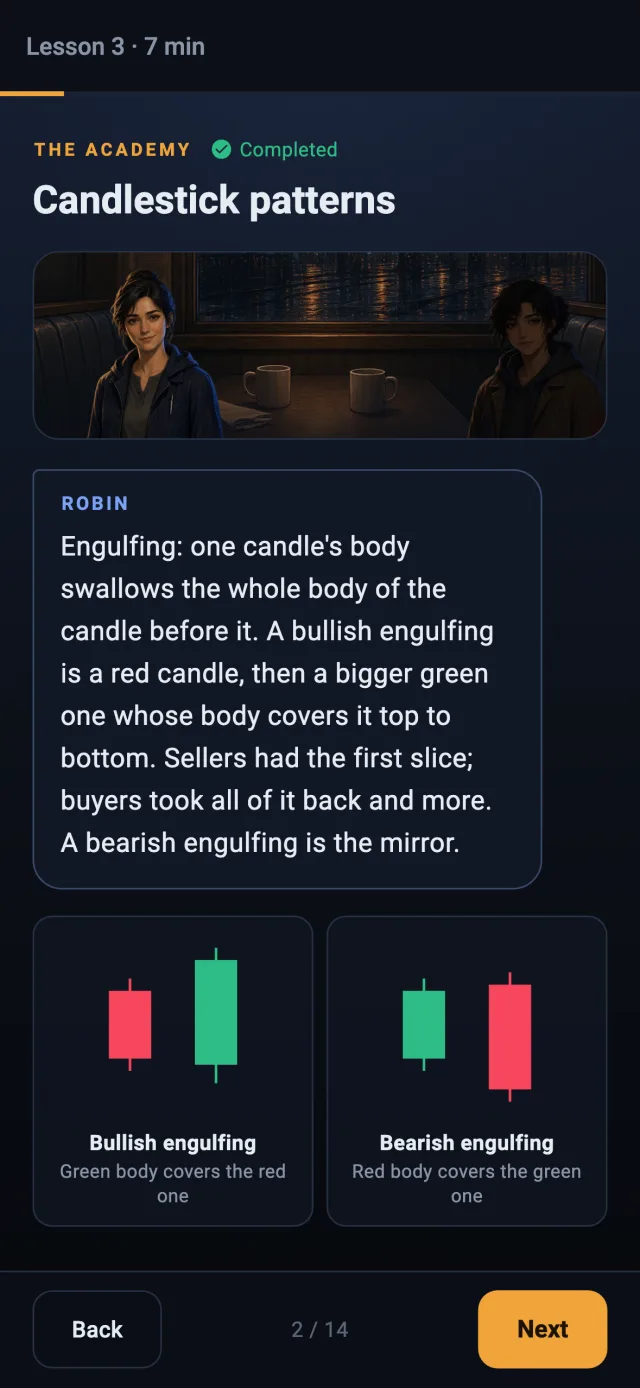
 Candlestick patternsEngulfing, hammer, shooting star, doji and inside bar — what they hint at, and why where they form matters more. · 7 min · 5-question quiz
 Chart patternsDouble tops and bottoms, triangles, flags, head and shoulders — the breakout level, the measured move, and the stop. · 7 min · 5-question quiz
 Volume and volatilityVolume that backs a breakout, ATR as the normal candle size, stops outside the noise, and the squeeze before the move. · 7 min · 5-question quiz
 A market that never sleepsTrading around the clock: thin weekends, who is awake when, news spikes, gaps — and why a stop can fill worse than its price. · 6 min · 5-question quiz
Leverage, explained Pro
Opens in Chapter 2 · 2 lessons · 14 minutesMargin, liquidation, funding, futures and shorting: how they work, how they hurt, and how to earn them here.
 Leverage, margin and liquidationWhat borrowed money does to gains and losses, and exactly how this game's leveraged positions work: margin, liquidation, fees and funding. · 7 min · 5-question quiz
 Futures, perpetuals and shortingWhat futures and perpetual swaps are, how funding works here and out in the world, how shorting works and why its losses have no ceiling but liquidation. · 7 min · 5-question quiz
Strategies Pro
Opens in Chapter 4 · 5 lessons · 33 minutesWhat a strategy is, four classic ones, and how to test yours.
 What a strategy isAn edge you can describe in rules — setup, entry, stop, target and size — written down and testable. · 6 min · 5-question quiz
 Trend following and pullbacksTrade with the structure: wait for a pullback to a level or a moving average, enter as it turns, stop beyond the swing. · 7 min · 5-question quiz
 Breakouts and fakeoutsBuy stops above resistance, volume, the retest, and how a stop handles the breakouts that fail. · 7 min · 5-question quiz
 Range tradingBuy near support in a clear range, sell at the middle or the top, stop below the range — and know when the range is over. · 6 min · 5-question quiz
 Testing your strategySample size, a record of every trade, win rate, average R and expectancy — and why blind replay keeps hindsight out. · 7 min · 5-question quiz
Money outside the charts Pro
Opens in Chapter 4 · 3 lessons · 16 minutesEmergency funds, assets versus liabilities, and taxes on trading in the US.
 Trading money and living moneyEmergency funds, and why you never trade money that already has a job to do. · 5 min · 5-question quiz
 Assets and liabilitiesWhat costs you money every month, what can earn, and how lifestyle creep eats a raise. · 5 min · 5-question quiz
 Taxes on trading in the USHow US taxes treat crypto trades. General education, not tax advice. · 6 min · 5-question quiz
A simulation. No real money. Not financial advice.